A Scottish non-Jewish woman, who was murdered in Auschwitz after she had decided to stay in Budapest to care for Jewish orphans, was honoured in Edinburgh.
Jane Haining had moved from Edinburgh to Budapest in 1932 to work as a matron at a school for Jewish and Christian girls, run by the Scottish Mission to the Jews, where she was a popular and devoted figure.
In 1940, she had dismissed advice to return to Scotland from Hungary, preferring to stay to protect the girls she was overseeing.
A few weeks after the Nazi invasion of Hungary in 1944, Haining was betrayed. When Gestapo officers visited the school, they arrested her on eight charges, including working with Jewish people and reportedly weeping when putting yellow stars on the children.
She was deported to Auschwitz in May 1944, along with many of her students, and died two months later at the age of 47 due to the camp’s lethal living conditions.
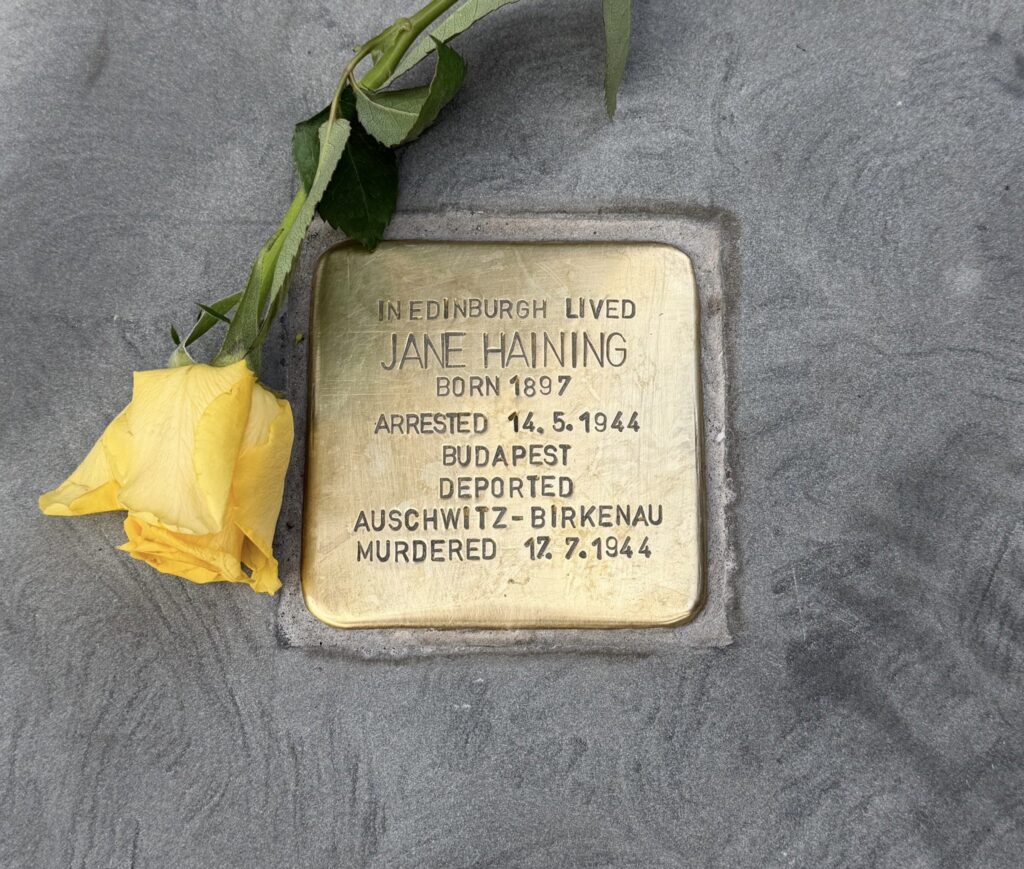
She was honoured at St Stephen’s Church in central Edinburgh, with the unveiling of a Stolperstein – a brass plaque inscribed with the name, date of birth, and date of death of a Nazi victim. In 1932, a service had been held at the same church for Haining shortly before her departure for Budapest.
Angus Robertson, Edinburgh Central SNP MSP, who instigated the plaque, told the BBC: “We must never forget the victims of Nazism or the lesson from history that persecution and extremism can tragically return.
“Jane Haining left Scotland for Hungary to help Jewish children, and rather than save herself, she tried to protect them and died in Auschwitz.
“It is right that Scotland’s first Stolperstein commemorated Jane Haining, and many thanks to the City of Edinburgh Council, who made its installation possible, and to Gunter Demnig, whose Stolperstein Project has become the largest decentralised memorial in the world.”
Stolperstein translates from German as “stumbling block.” The intention was for people to encounter the stones by stumbling across them and learning the stories of those persecuted during the Holocaust.
The name also inverts an antisemitic phrase used in Nazi Germany – people would say “a Jew must be buried here” when tripping on a protruding stone.