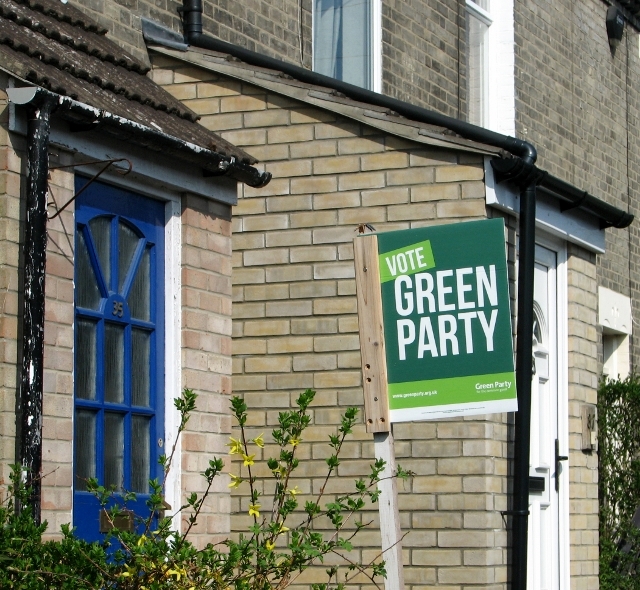
The Green Party of England and Wales voted at a closed conference to adopt a motion defining Zionism as a “racist ideology”, effectively rendering the party “anti-Zionist” in a move that has drawn criticism from many Jewish party members and senior party figures.
The motion was passed with 1,022 party members voting in favour and 813 against. By passing, the motion becomes official party policy in England and Wales, although it will not necessarily form part of the party’s election manifesto.
At the party’s conference in Brighton, the original motion, titled “Zionism is racism”, shifts the party away from its longstanding support for a two-state solution.
It describes Zionism as support for “an ethnonationalist Jewish state” and instead calls for a “single democratic Palestinian state in all of historic Palestine”, with Jerusalem as its capital and equal rights for all. It also recognises what it describes as the Palestinian people’s inalienable right to resist occupation and achieve self-determination “by all available means under international law”.
The party conference rejected several amendments, including one that would have clarified that members would not be sanctioned for attending Zionist synagogues, community centres or denominational groups.
The party did back an amendment ensuring that other Green Party policies would be updated to take account of the motion, according to the Guardian, which also reported that the campaign for the motion had been led by Greens for Palestine, an unaffiliated group that encouraged supporters to join the party to help secure its adoption.
Former Green Party co-leader Carla Denyer urged members ahead of the debate to reject the motion in its current form, warning that it could alienate Jewish supporters and distract elected Greens from practical measures aimed at helping Palestinians.
“If this motion passes as written, I’m concerned that elected Greens will be forced to spend our time and energy debating and defending definitions, at the expense of focusing on the essential actions that only we can take to make things materially better for people in Palestine,” Denyer said.
She added: “I also worry that the current wording risks alienating a significant proportion of Jewish people, including those who vehemently disagree with the Israeli government; support boycott, divestment and sanctions; and are strong advocates for Palestinian rights.”
Green Party leader Zack Polanski, who is Jewish, declared himself anti-Zionist last week as he campaigns in the Holborn and St Pancras by-election, where he is seeking to win the former seat of Prime Minister Keir Starmer.
Polanski has nevertheless backed amendments aimed at softening the proposal. He has called for language making clear that Jewish members should not face disciplinary action for attending synagogues that identify as Zionist, and supports replacing the call for a single Palestinian state with a commitment to a settlement guaranteeing equal rights and shaped by Palestinians themselves.
Asked by the BBC whether Zionism was racist, Polanski said it depended on how the term was defined.
“If your Zionism is the displacement of the Palestinian people, then that is clearly racist, and I say that as a Jewish leader of a British political party,” he said. Asked whether the motion amounted to calling for Israel’s eradication, Polanski replied: “That’s why I’m calling for an amendment.”
Israel’s Ministry of Foreign Affairs responded to the Green Party decision, saying it “gives legitimacy to terrorism” and that the party had adopted “not only the green of Hamas, but also its ideology: the elimination of the State of Israel through armed struggle”. The MFA said the move “goes far beyond the boundaries of legitimate political debate” and that political parties in the UK “must unequivocally reject this twisted resolution”.
The motion has drawn criticism from senior party figures. Deputy leader Rachel Millward has called it “problematic”, while former leader Caroline Lucas told the BBC: “I think there’s no single definition of Zionism and, irrespective of the intentions of those who put that motion, I think there is a real risk that it’ll be divisive and could be seen as a sign that Jewish people aren’t welcome in the party.”